
A Guide to Reading with the Tarot de Marseille
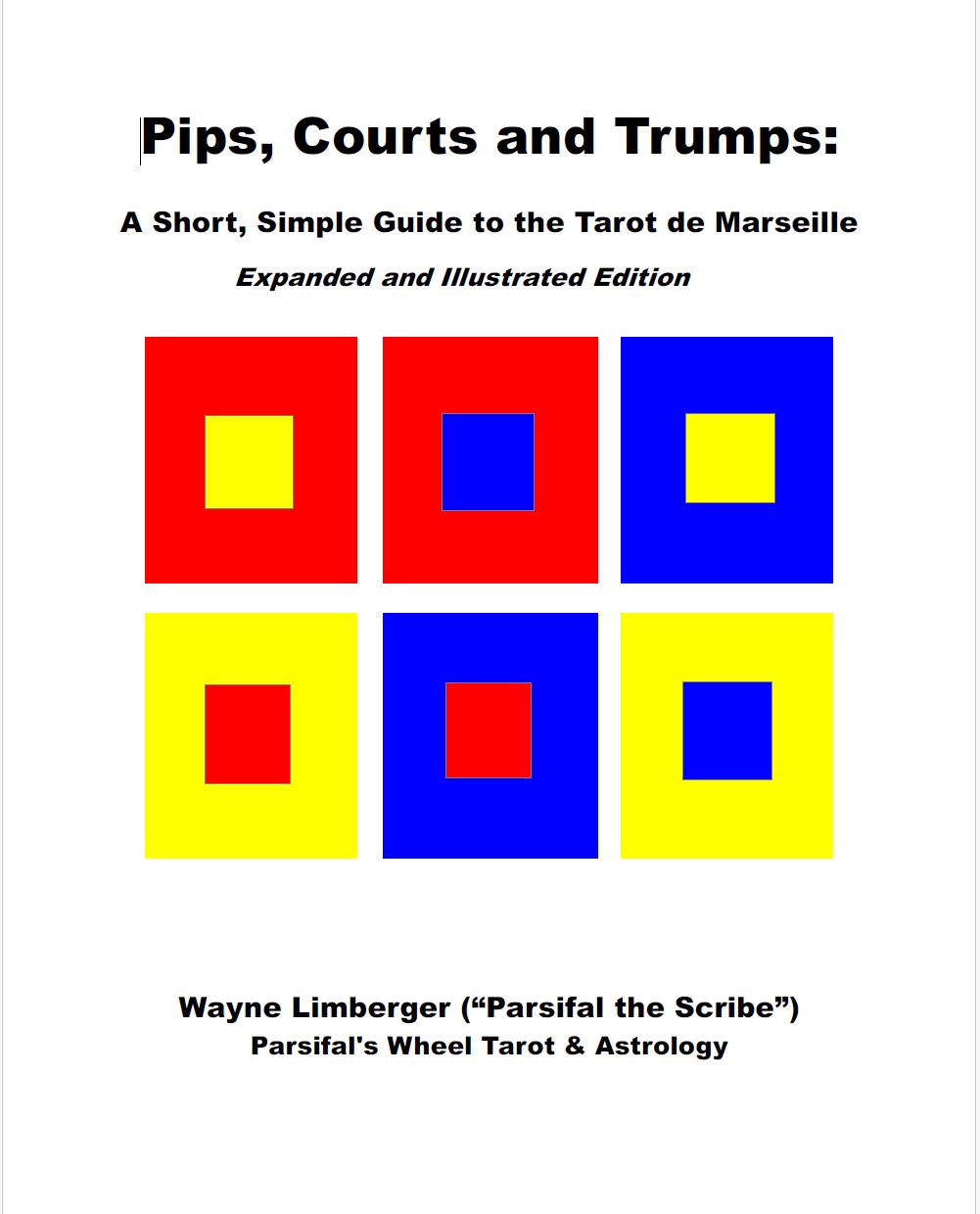
One of my favorite tarot bloggers, Wayne Limberger at ParsifalsWheelDivination.org, has come out with a guide to reading with the Tarot de Marseille (available at Lulu.Com). The author has been reading tarot for the public with the Thoth and Waite Smith decks for forty years, and has been blogging for nearly a decade. He knows how disorienting it can be to try reading with a deck that not only has no scenes on forty cards, but was created for playing a game with no reference to astrology, Qabala, or any other esoteric framework the reader might be familiar with. If you want to experiment with the Tarot de Marseille, Limberger provides a practical handbook filled with advice from an experienced reader who understands the struggle to read with those strange and abstract Tarot de Marseille cards.
Pip Cards
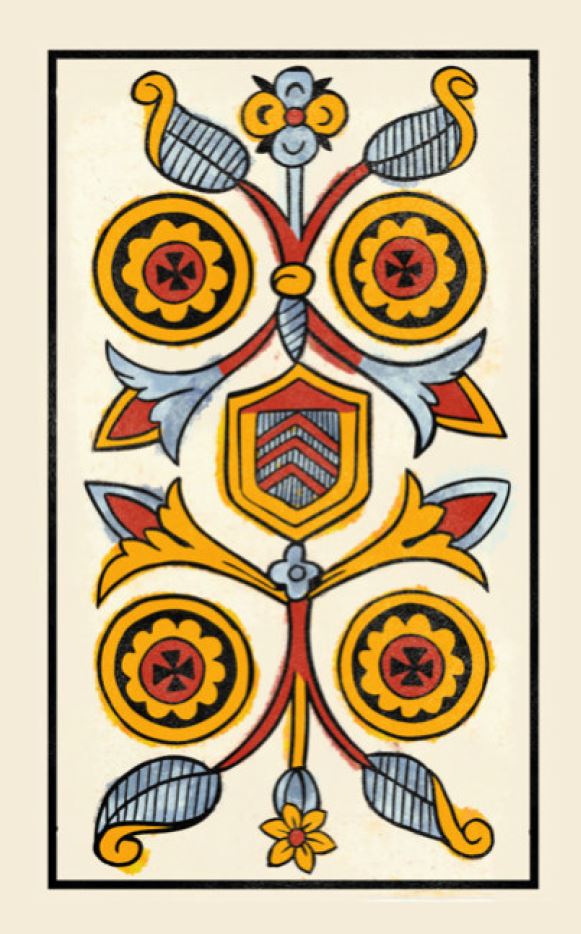
This 116-page e-book has three substantial sections dealing with the pip cards, court cards and trumps (major arcana). The book really shines when discussing the pips. The author sets out to interpret the forty pip cards without referring to esoteric correspondences like the Golden Dawn’s Qabalistic and astrological attributions, and without importing card meanings from other books. He succeeds admirably and gives us some of the best writing on the pip cards I’ve ever seen.
I have to admit to a personal bias. I love the pips! I know these minimalistic cards, with no scenes to suggest their meaning, are a huge stumbling block for many people. But I see each card as a field of vibrating energy. There’s no need to apply attributions from esoteric systems as a crutch. Enrique Enriquez’s “visual poetry” approach to tarot underlies this section of the book, adding to the depth and poetry.
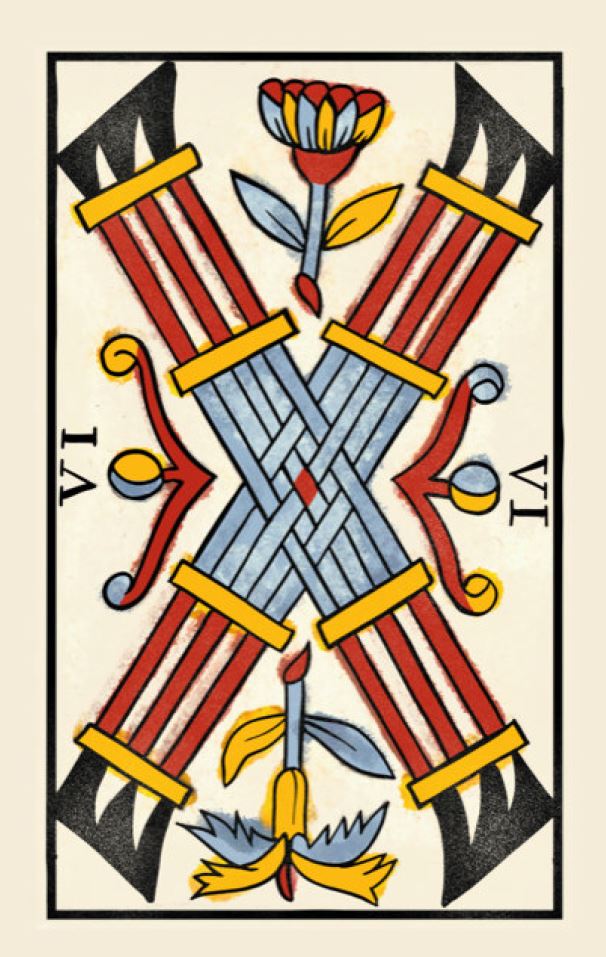

The section titled “Over Under Sideways Down” introduces us to the energy dance of the pip cards. Even-numbered Batons cards are described in terms of lines of force : “(They) have flowers and leaves that emanate from both the ends and the sides of the bundle of staves, implying an equilibrium of natural forces that signifies both breadth and depth of creative expression working in harness with the more directed outward focus of the staves themselves.” The discussion of even-numbered Cups focuses on their “vertical bisecting ‘spine’ of leaves and flowers that keeps the chalices strictly aligned and segregated, implying that there is little opportunity for creative intermingling of their contents.”
I’m thrilled to see an author remain faithful to the actual card, rather than falling back on “conventional” (Waite Smith) interpretations, such as interpreting the Eight of Batons as speed, and the Two of Cups as romantic love, when the images don’t support those interpretations. After reading Limberger’s poetic descriptions of the four suits, you’ll no longer see the pip cards as abstract and meaningless. In addition, he provides pithy one- or two-sentence descriptions for each card, making an excellent quick reference guide.
The beginner can easily get lost in a swamp of free associations, where any card can mean anything that pops into one’s head. The easiest way to stay grounded is by combining keywords for the suits and numbers. For instance, if the number four implies stagnation, and the suit of Cups is about emotions and relationships, then the Four of Cups can refer to a relationship that’s stuck in a routine. The book goes beyond lists of keywords to discuss the underlying basis of various systems of number and elemental symbolism, so readers can decide for themselves which system works for them.
Court Cards

The author begins this section by speaking to us as an experienced card reader who understands that it’s not easy to determine if a court card in a spread represents an actual person, a facet of the querant’s personality, an attitude they may or may not want to take, or just the general vibe of a situation. I was especially inspired by the discussion of “agency,” the power and authority imbued in each court personality to act in a certain way. The nature of this power is revealed in a court figure’s posture and gesture. The author gives us detailed descriptions of each court figure as a person, an attitude or behavior, or a general influence on a situation. Unlike the treatment of the pip cards, Golden Dawn elemental and astrological correspondences creep in, causing the descriptions to be somewhat detached from the visual reality of the card.
Trumps

The author tells us at the outset that he doesn’t see much in the twenty-two Tarot de Marseille trump cards that’s useful for a modern reader. Since these designs come from a time when tarot was just a game and not used for divination, he falls back on Jungian archetypes and Golden Dawn correspondences, completely missing the rich web of cultural and artistic associations that resonate with the late Renaissance and early modern periods, when the Tarot de Marseille entered the scene and the game was at its height of popularity.
His description of the Papesse card shows what can happen when you try to reconcile historic card images with the familiar and comfortable Golden Dawn attributions, while having little understanding of the card’s historical context. In this book, La Papesse is identified with Pope Joan, described as virginal (which the mythical Pope Joan certainly was not), and associated with the Moon and all things secret and mysterious, especially hidden knowledge. We’re told there are two columns behind the Papesse, which actually don’t exist in this deck. Nothing mentioned has any relevance to the Tarot de Marseille Papesse–it all comes from the Waite Smith/Golden Dawn tradition. Trying to reconcile Anglo-American esoteric correspondences with centuries-old European cards just leads to frustration, and to readings that are unmoored from the reality of the cards on the table. To understand the Tarot de Marseille trump cards, I suggest reading books by Europeans like Jodorowsky, Ben Dov or Elias who have spent their tarot careers outside the Waite-Smith/Golden Dawn box.
I highly recommend this e-book if you are experimenting with the Tarot de Marseille and are feeling intimidated. For experienced TdM readers, the pips section offers a rich trove of images. If your previous tarot experience is grounded in the Waite Smith deck, this book makes a nice bridge between the two systems.
LINKS
Wayne Limberger’s website and blog
https://parsifalswheeldivination.org/
Limberger’s blog page where he lists links to his Lulu e-books
https://parsifalswheeldivination.org/my-publications/
Link to purchase the Tarot de Marseille book
https://www.lulu.com/shop/wayne-limberger/pips-courts-and-trumps-a-short-simple-guide-to-the-tarot-de-marseille/ebook/product-5mm5rp.html?page=1&pageSize=4
The book and this article are illustrated with the Jean Noblet Tarot (Paris c.1650) restored by Shell David at Easttarot.com

 Tarot Heritage
Thanks so much, Sherryl. In retrospect, I’ve always had reservations about how I handled the trump cards, and my thinking has evolved some since that time through my engagement with the Tarot History FB page.
But for me there is still a gap to fill between the historical representation of the trumps and their modern use in divination. In more recent essays I’ve portrayed them not as signifying major events but rather as environmental backdrops for circumstances highlighted by the pip and court cards.
It may seem like a bit of a dodge, but in my own practice I’ve never found Eden Gray’s assumptions about their potent situational influence to be legitimate. In that sense, a more historical perspective works for me.
Hi Wayne, I like your idea of using the trump cards as background circumstances. I’ve always considered the pip and court cards to be the meat of a reading – what you are actually grappling with. We get trump cards in nearly every reading, but our lives are usually not that dramatic.
I’ve gotten the Tower the day someone cancelled a lunch date at the last minute, and days when someone dropped in on me unexpectedly — little surprises that aren’t life changing. Then I got the Three of Cups the day my best friend died with three people sitting around her bedside.
Tarot is a visual language, and I don’t think the cards get hung up on whether you pulled a major or minor arcana card. They just show you the picture you need to see at the time.