
Il Sole/Le Soleil/The Sun

The radiant sun. It shines on everyone equally, nurturing life and pouring down blessings from heaven. For centuries, this card has signified joy, abundance, success, and happy relationships. Although the card’s interpretation has remained constant, the illustrations on the card have varied greatly over the centuries. Let’s look at some unique Sun cards, then examine certain themes that have persisted for centuries.
One-of-a-Kind Tarot Sun Cards
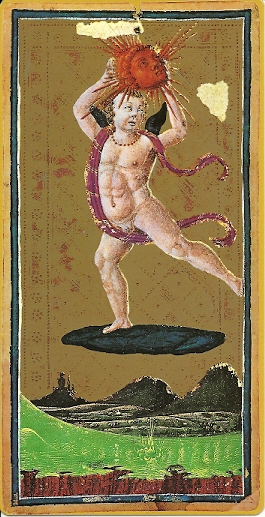

In this card, hand painted for the Duke and Duchess of Milan about 1475, a putto moves across the sky on a cloud, holding the mask of Helios over his head. Late in the Roman empire, the Sun was personified as Helios and came to be associated with Apollo. Helios/Apollo was usually depicted wearing a crown of sun rays and driving a chariot with four white horses from east to west across the sky. At the same time, Christ was often depicted on wall frescos as a youthful Apollo. Certain passages in the Bible can be interpreted to support the identification of Christ with the Sun. In the Gospel of Matthew (17:2) Jesus took three disciples to a mountain where he was transfigured so that his face shone like the sun. In three places in the Gospel of John, Jesus describes himself as “the light of the world.” Correlations with the Bible like these allowed renaissance Christians to depict pagan deities in their art with a clear conscience.
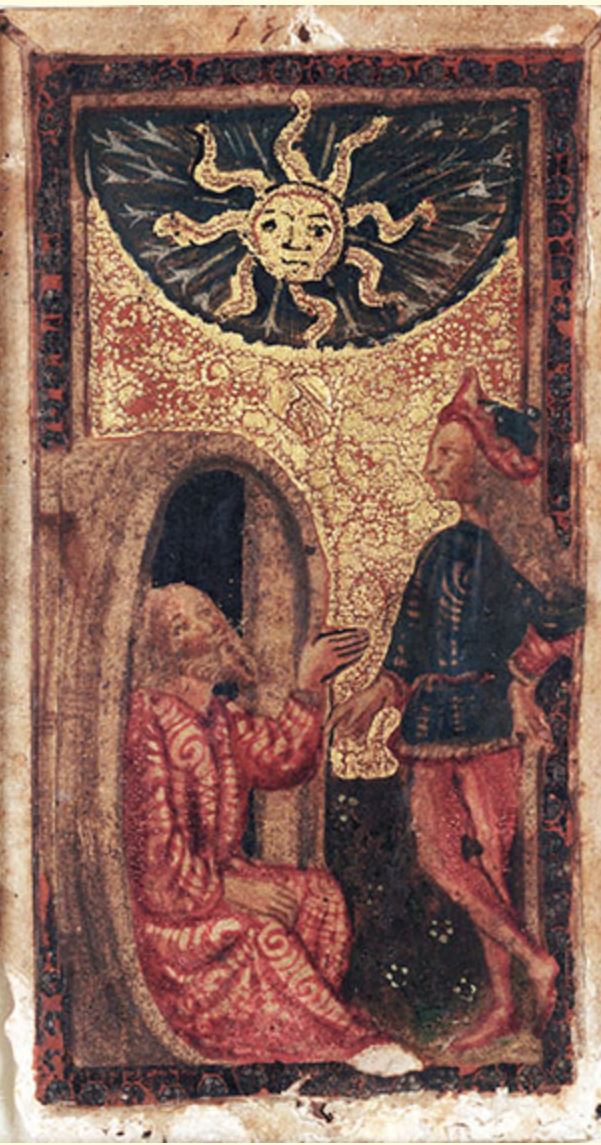
The story of Alexander the Great meeting the Cynic philosopher Diogenes was repeated in literature from the time of Plutarch in antiquity to Shakespeare in the early modern period. Diogenes modelled what he believed to be a natural, stress-free life by owning no possessions and living in a barrel. One day, Alexander visited Diogenes and asked the philosopher if he could do anything for him. Diogenes responded, “Yes, step aside please. You’re blocking the sun.” This encounter was illustrated on a Sun card painted in mid-15th century for the Duke of Ferrara.


In the Budapest deck, block printed in Italy just before 1500, the benevolent Sun pours life-giving rays on a forest or orchard. In the French Tarot de Paris, printed in Paris about 1650, a monkey holds up a mirror for a woman with very long hair. This Sun card could be an allegory of Vanity.
Woman with a Spindle

The earliest known Sun card that shows a woman with a distaff and spindle is in the so-called Charles VI deck that was painted for an Italian aristocrat in the mid-15th century. A woman carrying a spindle was a common sight in pre-modern times. Women spun yarn as they walked to market, tended their animals, or waited for the porridge to boil. The spindle became a symbol for a respectable and hard-working housewife. The revolving spindle is analogous to the Sun’s daily revolution around the earth, making the card a reminder to take advantage of the daylight to get work done. This image has been associated with Clotho, the Fate who spun the thread of an individual’s destiny.

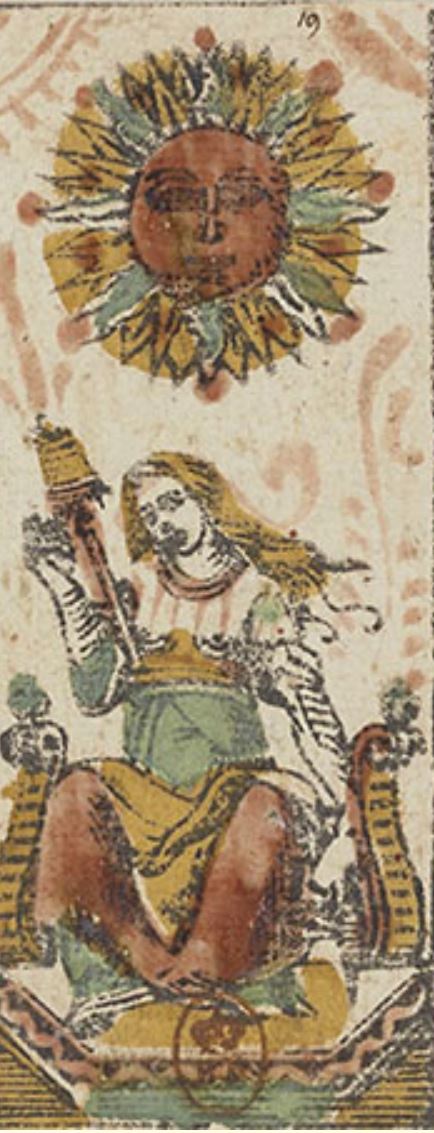
A seated woman with her distaff and spindle became the standard image of the Bolognese Sun card quite early in Tarot’s history. The Dalla Torre card printed in the 17th century is nearly identical to the Sun card from the uncut sheet of cards that dates from around 1500.
Child on a Horse


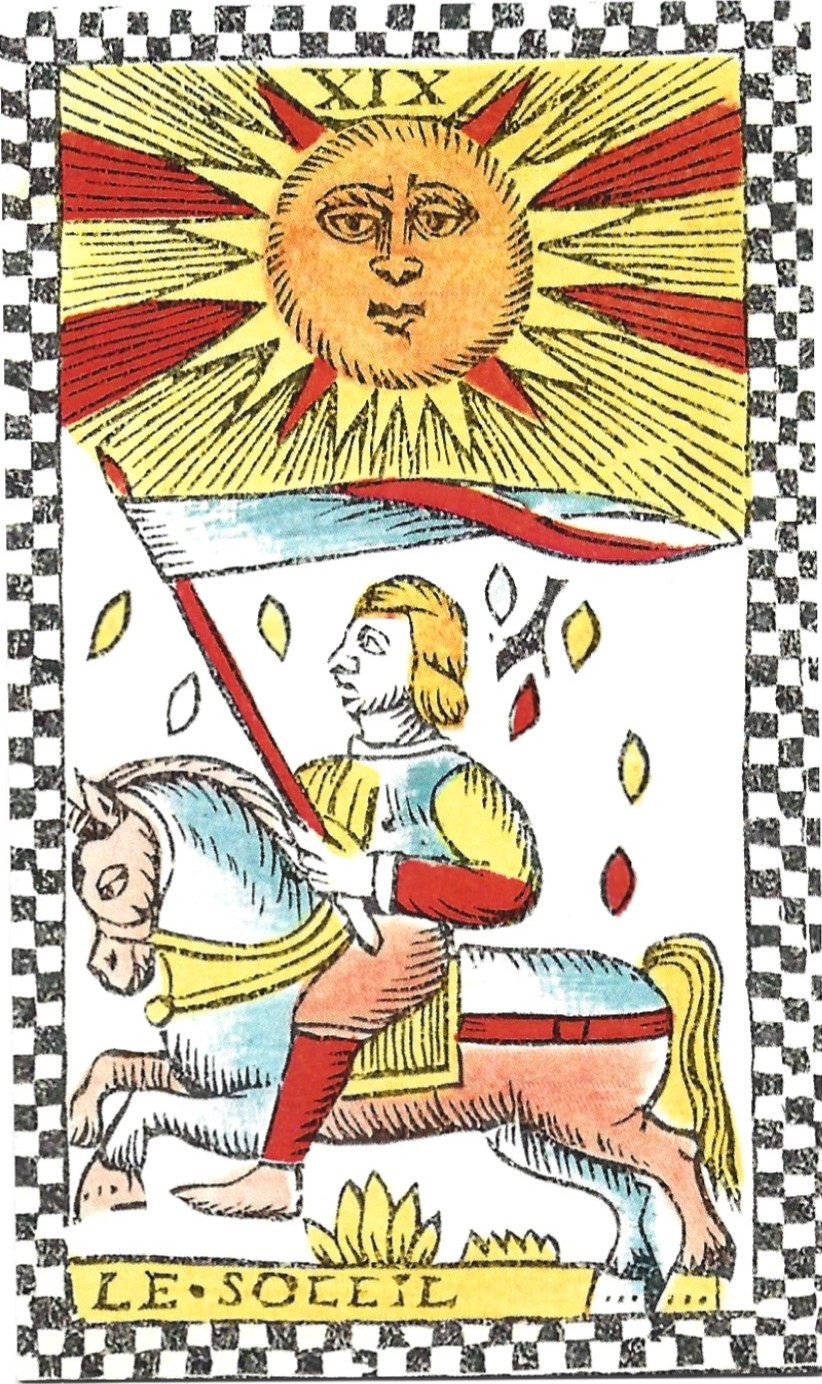
A naked youth holds a banner aloft under a blazing sun as he gallops across a field on a pale horse. This Sun card image first appeared in the Vievil deck published in Paris about 1650. The youth on a horse reappeared in the Rouën-Brussels pattern that was popular in Belgium and northern France from the late 1600s to mid-1700s. The de Hautot card shown here is the only Sun card where the youth is dressed. This type of Sun card introduced new symbols that were adopted a century later by French and British occultists.

The banner the youth holds aloft on the Vandenborre card, shown above center, displays a red cross on a white background. This insignia was carried into battle by crusaders. Images of the resurrected Christ rising from his tomb often show Him holding this banner to symbolize His triumph over death. Occultists interpreted the boy with the banner as a soul being liberated from the material world and about to be taken up into heaven. Since this card appears immediately before the ascension to heaven in the Judgment card, it’s often seen as the transition point between material and spiritual worlds, where the embodied spirit transforms into pure spirit.
Two Children
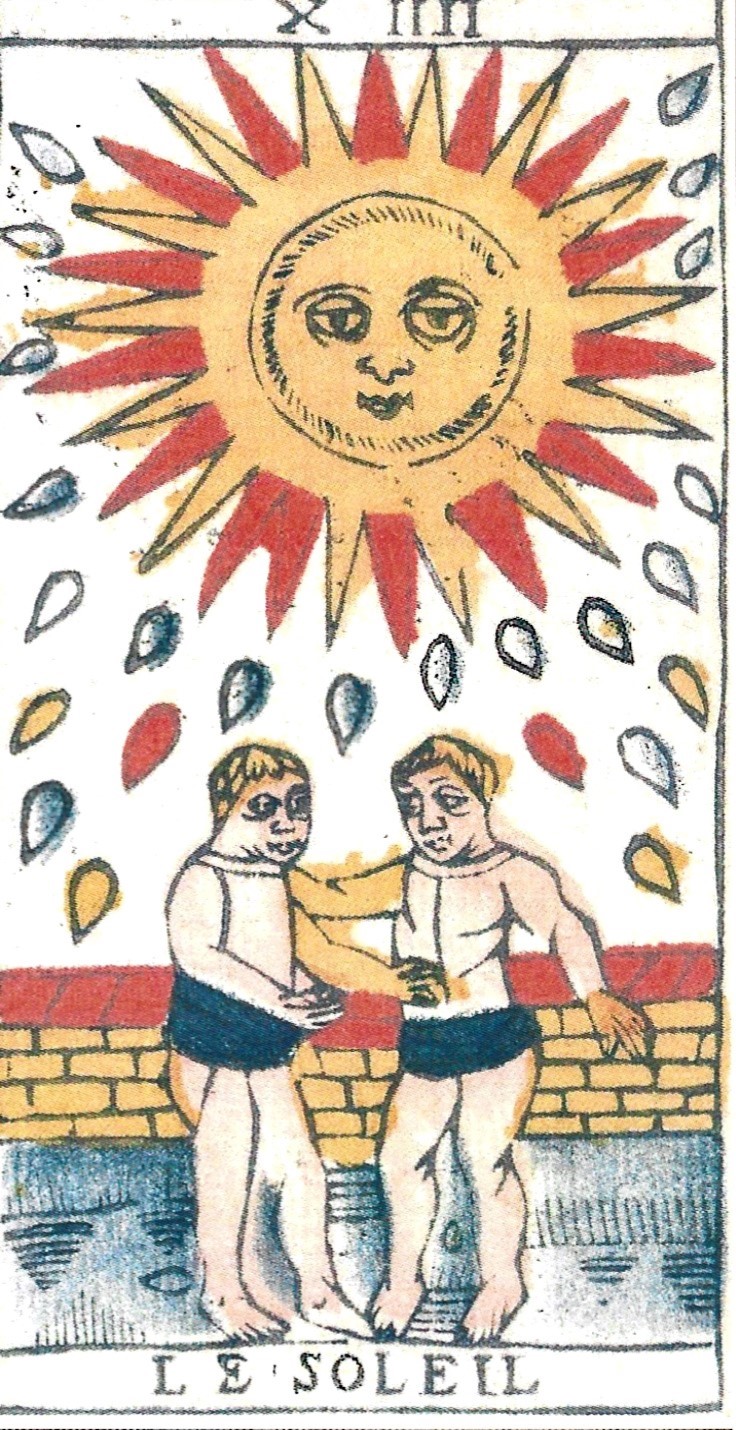

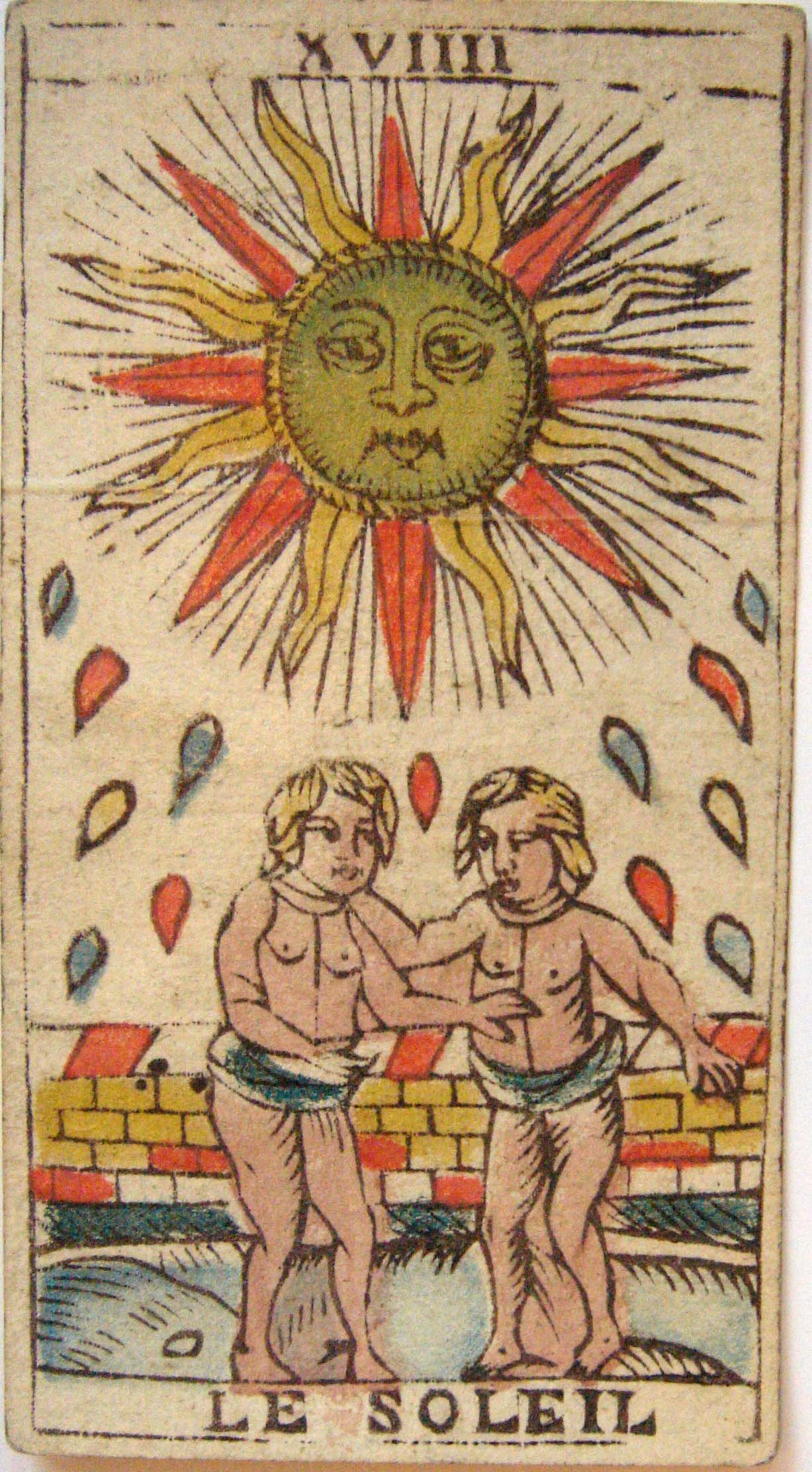
The Tarot de Marseille, which appeared in eastern France in the early 17th century, displays two children on the Sun card. This design has been the standard tarot Sun image in Europe for four hundred years; and it’s the image occultists associated with the Sun from the 18th to 20th centuries.
A huge sun takes up the top half of the card. Drops of moisture are drawn up toward the sun, possibly imitating the alchemical operation of evaporation and condensation.
Two children, usually rendered as nearly identical boys, stand in front of a brick wall. In earlier decks, like the Payen (printed in 1743 using woodblocks from the early 1600s), the children appear stiff and awkward, while in later decks they’re more animated. The boy on the left seems distressed or puzzled. He reaches out to the boy on the right, who puts his arm on his shoulder and seems to be either consoling or guiding him.
The brick wall makes a safe enclosure that some authors see as a type of paradise, like the Garden of Eden, a playground for carefree and innocent children.
The boys in the Tarot de Marseille Sun card are most often associated with brothers who appear in mythological stories.
The twins Castor and Pollux have several attributes that connect them to the Sun card. They were both expert horsemen, and Pollux was a champion boxer. We’ll see below that the Sun is associated with athletes. Castor’s father was a mortal king, while Pollux was a son of Zeus. When they both died, Pollux had the option of spending eternity on Mt. Olympus. But he gave half his immortality to his brother so they could spend eternity together, alternating between earth and the realm of the gods. In another version, they spend eternity together as the constellation Gemini.
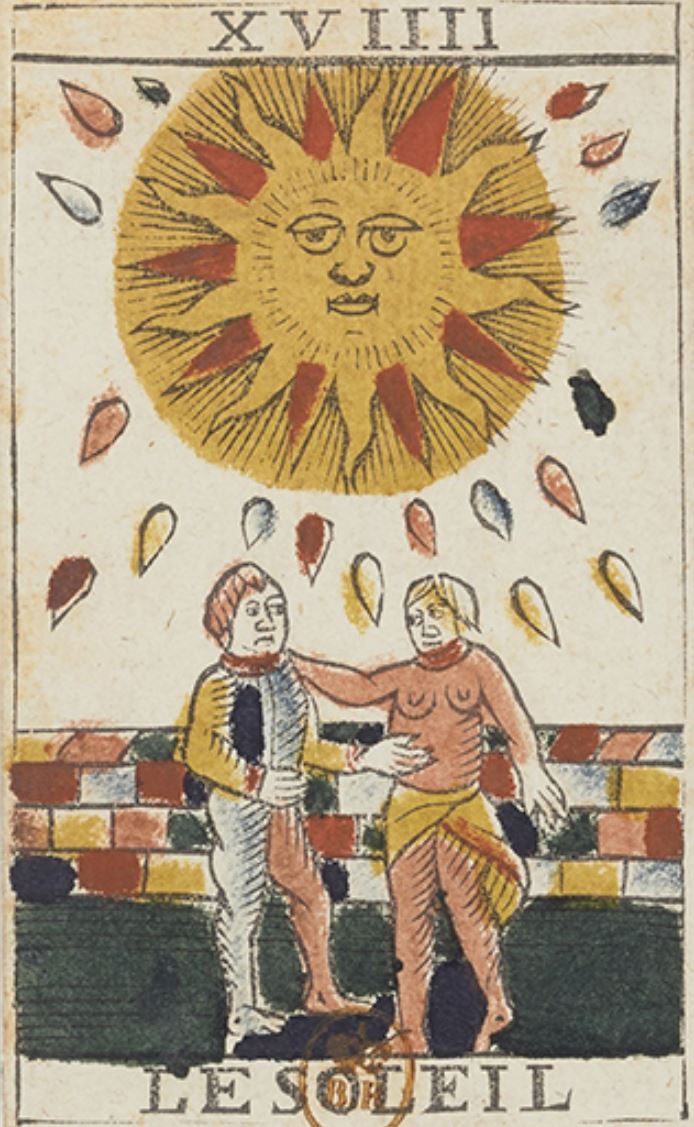

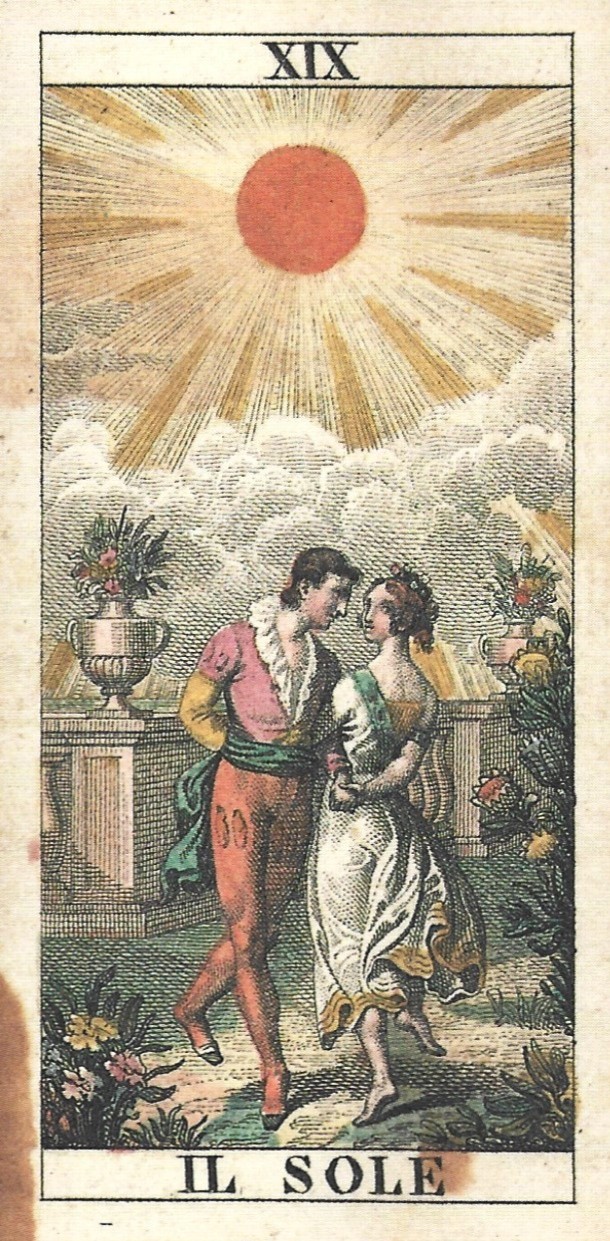
Many Sun cards show a boy and girl rather than two boys. The Noblet, one of the first Tarot de Marseille decks, might show a boy and a girl—the image is rather ambiguous. When the Tarot de Marseille became popular in Italy in the 18th century, Italian card makers adjusted some of the images to appeal to local tastes. In the Piemontese deck in the center, the couple stand rather awkwardly, like the two boys in the traditional Tarot de Marseille. The 1835 Soprafino deck by Carlo Della Rocca shows a well-dressed couple dancing in a walled garden. Card printers in Lombardy and Piedmont copied this card, as well as other tarot images by Della Rocca, throughout the 19th century.
Children of the Sun
Today we have “sun sign” astrology, the belief that your zodiac sign influences your personality. In the Renaissance, they had “Children of the Planets,” the belief that one planet ruled your destiny and influenced your occupation, personality, and physical appearance. For instance, if you were a professional soldier, or had a hot temper, or red hair, you were a child of Mars.
Just as the sun is the center of our universe, radiating warmth and light, so children of the sun are charismatic, of noble rank, and naturally the center of attention. Children of the Sun Illustrations always included aristocratic young men practicing the kind of sports preferred by the upper class like fencing, wrestling, gymnastics, and weight lifting.

This detail is from a Children of the Sun print that shows men fencing, lifting weights, and wrestling in a palace courtyard, while people look on from upper windows. Wrestlers were always included as Children of the Sun. In better quality engravings, such as this one, the athletes are rendered very realistically. In cruder block prints, the wrestlers stand next to each other, facing forward with their arms on the other’s bodies, looking very much like the awkward boys in Tarot de Marseille decks.

Each of the twelve houses in a zodiac wheel corresponds to an area of life that is ruled by a planet. The fifth house, ruled by the sun, is associated with children and pleasurable activities. Shown here is the bottom panel of a page from a fortune telling book published in Milan in 1508. The page relates to the Sun, and the panel shows children playing. The pair on the left are very similar to the Tarot de Marseille children. For centuries, the image of joyful, innocent children playing unselfconsciously in a walled garden inspired interpretations of the Sun card that included spontaneity, a carefree attitude, and creativity.
Occult Tarot
French Occult Tarot
The 19th-century French ceremonial magician Eliphas Levi aligned tarot with the Hebrew alphabet, and put tarot at the center of the western occult tradition. In his book Transcendental Magic, his description of his ideal deck follows the Tarot de Marseille closely. His Sun card has two naked children holding hands in a fortified enclosure. Levi was aware of other types of decks because he goes on to say that some decks show a “spinner unwinding destinies” (Rouën-Brussels pattern), and others have a naked child mounted on a white horse and displaying a scarlet standard (Jacques Vievil deck). A. E. Waite used this last description for his Sun card.
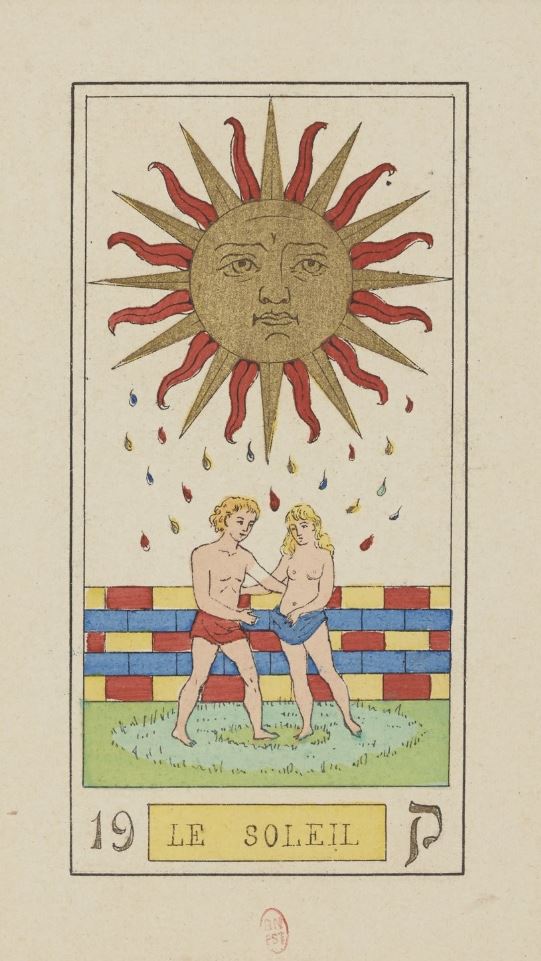
Levi doesn’t mention the gender of the two children, but two of the most influential occultists of the early 20th century, Papus and Oswald Wirth, said the two children illustrate positive and negative polarities. Wirth depicted the Sun’s children as a youthful boy and girl with gold raining down on them from heaven. In the nineteenth arcana, according to Wirth, we haven’t yet ascended to heaven. The wall behind the children indicates we’re still in the material world. The sun keeps us anchored in the visible world. At this stage we’re still a spirit trapped in a body undergoing purification so we can unite with Universal Spirit.
Wirth’s card interpretations seem to derive from associating the sun with Apollo: Culture, the arts, harmony, friendship, generosity, nobility, clarity of judgment, honors, and celebrity.
English Occult Tarot
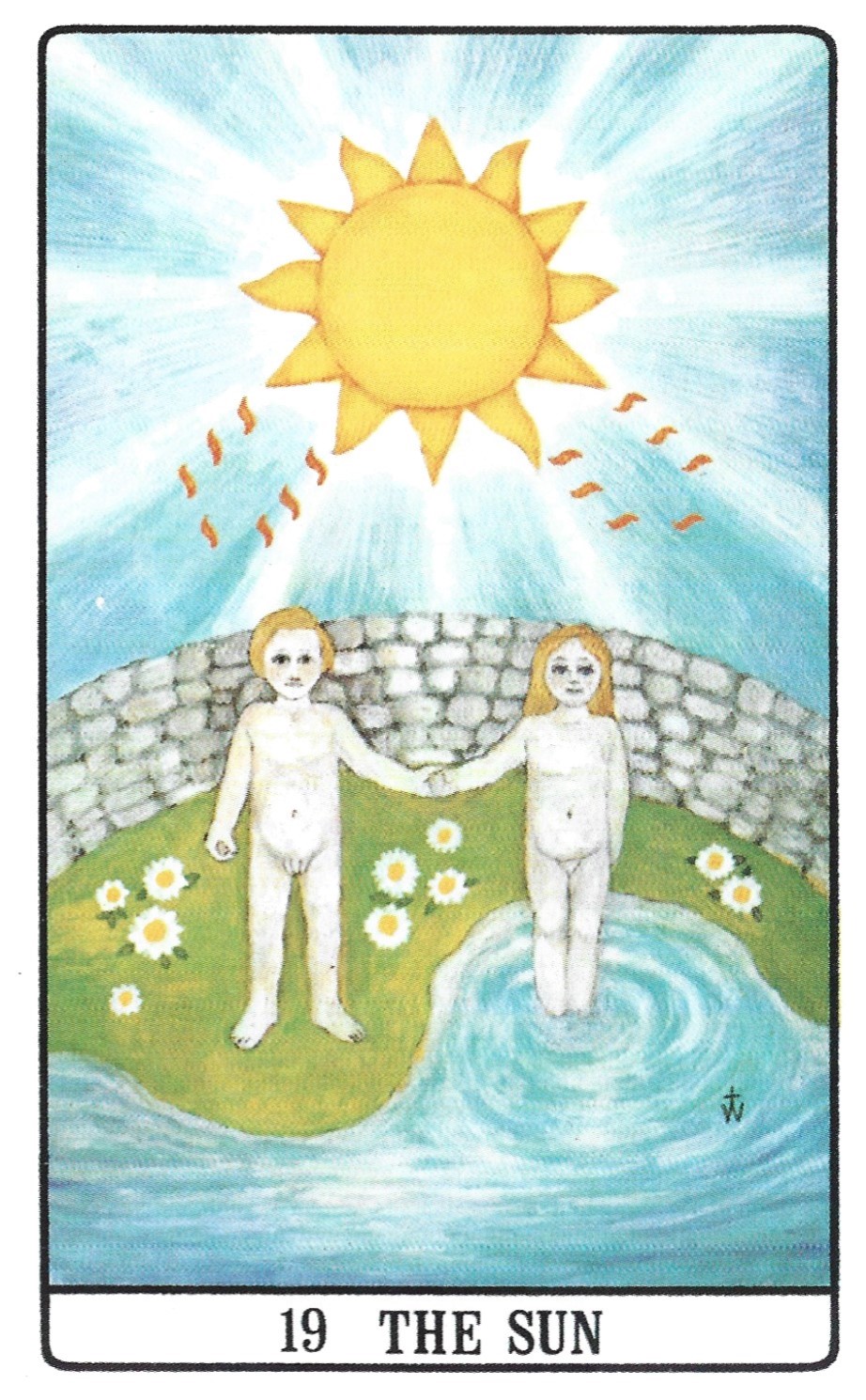
The London-based Hermetic Order of the Golden Dawn named the Sun card the “Lord of the Fire of the World” and associated it with dying and resurrected gods like Adonis and Balder. This card represents the point where knowledge of higher realms is made available to the lower self.
In the Golden Dawn’s deck, a naked boy and girl hold hands in front of a wall, an image very similar to the Tarot de Marseille. The boy stands on green grass while the girl stands in a pool of water. The drops falling from the sun have been changed to Yods, the first letter of God’s name in Hebrew.
The Golden Dawn’s card interpretations are conventional: gains, riches, happiness, glory and joy. Their negative card meanings seem to derive from negative aspects of the zodiac sign Leo: vanity, arrogance, and the need to be admired.

Arthur Edward Waite translated Eliphas Levi into English and was influenced by Levi’s description of this card as a “naked boy on a horse with a red banner.” According to Waite, the walled garden behind a stone wall is our material world lit by the earthly sun. In Waite’s card, the boy is riding away from the wall because he has been liberated and is making the transition from this world to a transcendent realm. Waite asserts that transformed humanity is simple and innocent like a naked child. There is perfect harmony between the transformed consciousness and one’s animal nature, just as the child and his horse are in harmony.
Interpreting the Sun Card
The sun’s qualities give us traditional interpretations of this card: material abundance, good luck, and a happy marriage.
The twin children bring in concepts of harmonious friendship, brotherhood, and personal connections that are totally open and trusting. For the spiritually minded, the naked children symbolize innocence, and a pure soul purged of all attachments and ready to ascend to heaven. Modern interpretations focus on the magical inner child – creative, spontaneous, unselfconscious, joyful and carefree. The walled garden is a safe place to play, explore, and be creative. By extension, the card can indicate a stress-free vacation, success in the creative arts, or an attitude of curiosity and a desire to explore the world.
Since the children of the sun are aristocrats and powerful people, this card in a reading can indicate receiving benefits from high status people, mentors or father figures.
Modern Decks


The Robin Wood Sun card is very similar to the Waite Smith card. Wood has minimized the wall and made the sunflowers brighter and more prominent. The child wears a crown of white roses with a red feather, like her version of the Fool, emphasizing the child’s innocent nature. Like the idealized inner child, he is joyful, free, and spontaneous. In both Waite’s and Wood’s cards, the sunflowers point to the child rather than toward the sun because the child shines brighter than the sun.
The Light Seer’s card expresses pure joy and an open heart that says “yes” to life. It depicts the confidence and trust that comes from knowing you are supported by the universe.
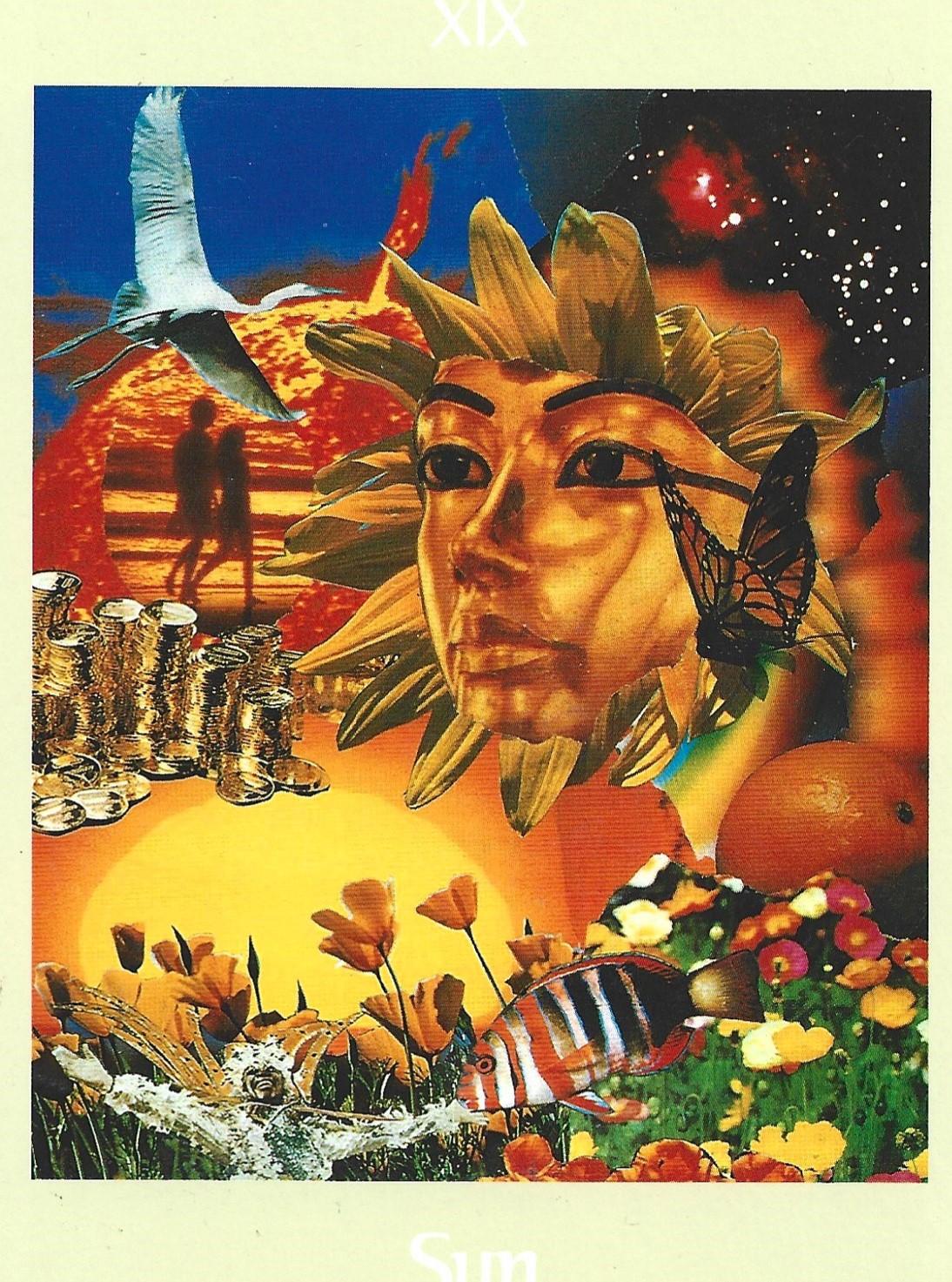
The golden mask with rays of sunflower petals on the Voyager card looks like the Visconti-Sforza Helios mask. The stacks of gold coins symbolize abundance and blessings. As a native of the golden state, California, the artist includes emblems of that state: Golden poppies, monarch butterflies, an orange sunset over the Pacific ocean, and colorful striped fish.
See more cards and art at TarotWheel.net
https://www.tarotwheel.net/history/the%20individual%20trump%20cards/el%20sole.html
Read the Introductory article on the Star, Moon and Sun cards here.
Illustrations
Sun. Splendor Solis. C. 1500
I Tarocchi Visconti Sforza. Milan c.1450. Reproduced by Il Meneghello, Milan, 2002. Collection of Pierpont Morgan Library, New York City.
Helios. Greco-Roman fresco. Collection of Archaeological Museum of Sparta.
Ercole d’Este Tarot. Florence/Ferrara mid-15th century. Collection of the Beinecke Library, Yale University, New Haven, Connecticut.
Budapest Tarot. Late 15th century. Recreated by Sullivan Hismans, Tarot Sheet Revival, 2017. Collection of the Museum of Fine Arts, Budapest and the Metropolitan Museum of Art, New York City.
Tarot de Paris. c. 1650. Facsimile by André Dimanche/Grimaud, 1980. Collection of Bibliothèque Nationale Française, Paris.
Tarocchi Charles VI. c. 1460. Collection of Bibliothèque Nationale Française, Paris.
Rothschild Sheet. c. 1500. Collection of Bibliothèque de l’Ecole Nationale Supérieure des Beaux-Arts, Paris
Tarocchi Fine Dalla Torre in Bologna. 17th century. Collection of the Bibliothèque Nationale Française
Tarot de Jacques Vieville. Paris, mid-17th century. Collection of the Bibliothèque Nationale Française. Facsimile produced by Heron Boechat, Bordeaux, c. 1980.
Tarot Flamand Vandenborre. Brussels, 1762. Restored by Pablo Robledo, Argentina, 2018.
Adam C. De Hautot Tarot. 18th century. Recreated by Sullivan Hismans, Tarot Sheet Revival, 2020.
Resurrection. Rafaellino del Garbo, 1505. Galleria dell’Accademia, Florence
Tarot de Marseille Jean Payen. Avignon, 1743. Facsimile by Marco Benedetti, 2023
Tarot Nicolas Conver. Marseille, 1760. Restored by Yves Reynaud, 2017.
Jean-Pierre Laurent Tarot. Belfort, 1735. restored by Yves Reynaud, 2020
Jean Noblet Tarot. Paris c. 1650. Restored by Joseph H. Peterson, 2016. Collection of Bibliothèque Nationale Française, Paris
Tarocco Piemontese Strambo. Varallo, late 19th century. Il Meneghello, 2014
Tarocco Soprafino di Gumppenberg, 1835. Il Meneghello, Milano 1992. Collection of The British Museum
Children of the Sun, detail. Albrecht Glocktendon, Nuremberg 1531.
Libro de la Ventura. Lorenzo Spirito, Milan, 1508. Rosenwald Collection, Library of Congress
Oswald Wirth Tarot. 1887. Collection of the Bibliothèque Nationale Française, Paris.
The Golden Dawn Tarot. Robert Wang and Israel Regardie. U.S. Games, Systems Inc., Stamford, CT, 1977.
The Centennial Waite Smith Tarot Deck. London, 1909. U.S. Games System, Inc., Stamford, CT, 2009.
The Robin Wood Tarot. Robin Wood. Llewellyn Publications, 1991
The Light Seer’s Tarot. Chris-Anne. Hay House, Inc., 2019.
Voyager Tarot. James Wanless. Merrill-West, 1986.
See the separate Bibliography for books that discuss all the trump cards.

 Tarot Heritage
Instead of the Greek Castor and Pollux, could it be that the twins were the Roman Romulus and Remus?
Yes, others have suggested Romulus and Remus. It’s not one of my favorite theories, so I didn’t mention it.