
The History of Tarot by Giordano Berti
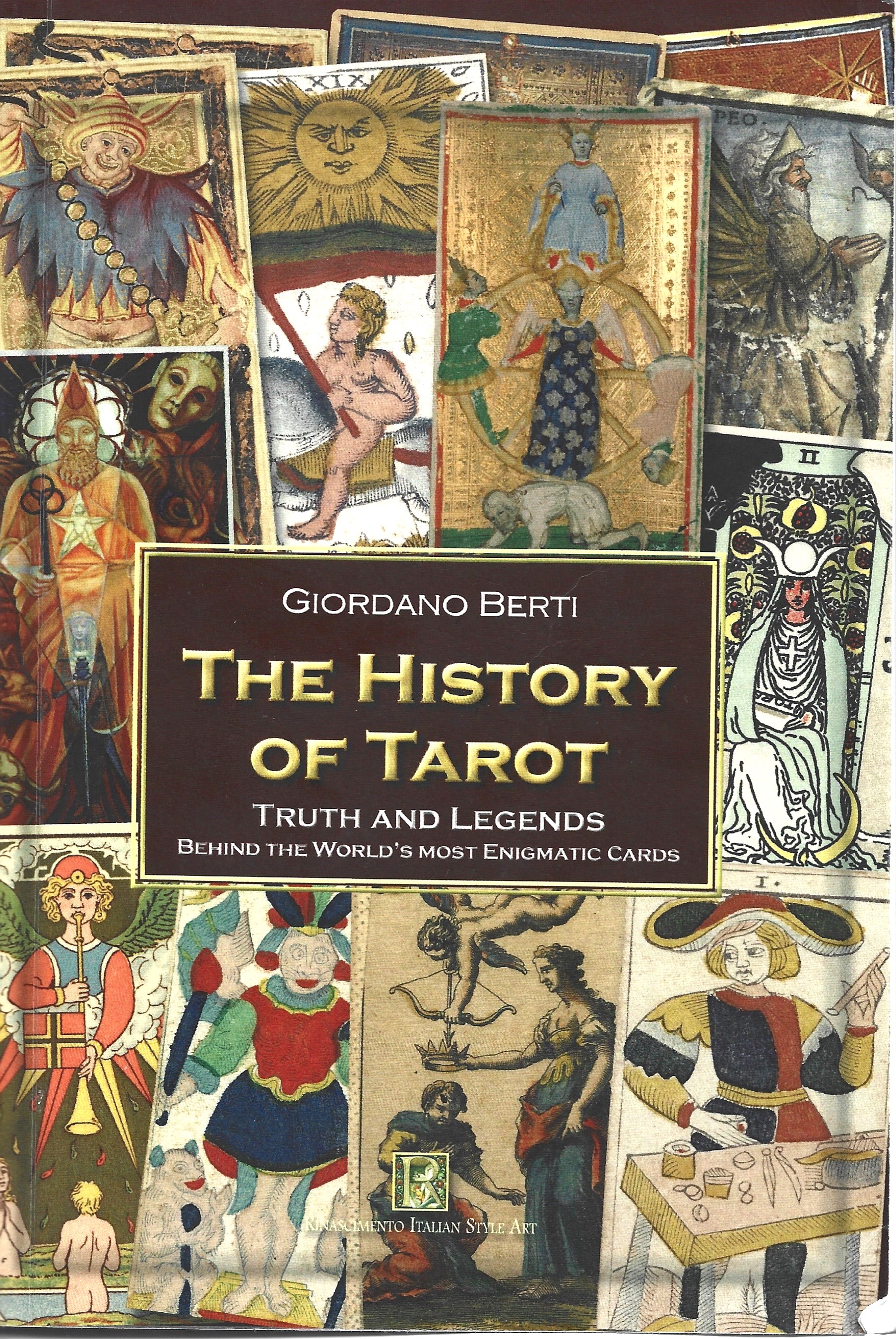
I desperately needed this book twenty-five years ago when I began looking into tarot history. Back then, I had to cobble together a coherent story from online discussions, Kaplan’s Encyclopedias, and a few exhibit catalogs. Berti’s book has everything an aspiring tarot historian could possibly need. This moderately priced, generously illustrated, 375-page paperback reads like a novel but contains a comprehensive narrative of tarot history.
The book’s first 122 pages cover the early history of tarot, starting with fourteenth -century playing cards, then discussing every fifteenth-century deck that still exists: the hand-painted aristocratic decks, the few block-printed decks that survive, uncut sheets of cards, and the regional variants taking shape in places like Bologna and Piedmont. We read about the merchants, artists, and accountants who left written clues behind. The story continues with those delightfully quirky pre-TdM decks from sixteenth-century France, like the Catelin Geoffroy tarot. For someone like me who is mostly interested in pre-TdM decks, Berti’s comprehensive treatment of early tarot is invaluable. The Tarot de Marseille discussion is just as comprehensive, covering every variant like the Besançon and Rouën-Bruxelles patterns, as well as oddities like the Noblet and Vieville decks.
I approached the lengthy chapters on French and British occult tarot with some trepidation. This is Berti’s area of expertise, and I was afraid it would be written from the viewpoint of a true believer. As someone who is allergic to esoteric tarot (to put it mildly) I was pleased to read a very balanced and factual narrative that starts in France with De Gebelin, spans the centuries, and ends with the Jodorowsky-Camoin collaboration in the twentieth century. The British chapter focuses on the Golden Dawn and Crowley, before moving on to the United States where tarot became a fellow traveler with the New Age, as well as eastern religions, Jung, and psychotherapy.
Berti sets the record straight on certain myths and misconceptions, such as Prince Fibbia inventing Bolognese Tarocchino. He sorts out facts from gossip concerning Mademoiselle Lenormand, and gives the real story behind the four Moors in Bolognese decks. The chapter on tarot and literature covers everything from fifteenth-century artist’s contracts to contemporary cinema. This is followed by a chapter devoted to tarot as a tool for fortunetelling.
Berti and his translator, Alexandra Miron, conjured up literary magic. Even though I know most of the facts in this book, I compulsively read every word, as if drawn into a page-turning novel. Another excellent feature: when a deck is discussed, it’s illustrated on the facing page. No need to thumb through the book to find the illustrations clumped together in some random spot.
A word of advice: read the footnotes – all forty pages of them. They add depth and complexity to the narrative.
You’ll find everything you need to know about tarot history between the covers of this very readable book. It’s indispensable!
Berti, Giordano. The History of Tarot: Truth and Legends Behind the World’s Most Enigmatic Cards. Translated by Alexandra V. Miron. Rinascimento-Italian Style Art, 2025.

 Tarot Heritage